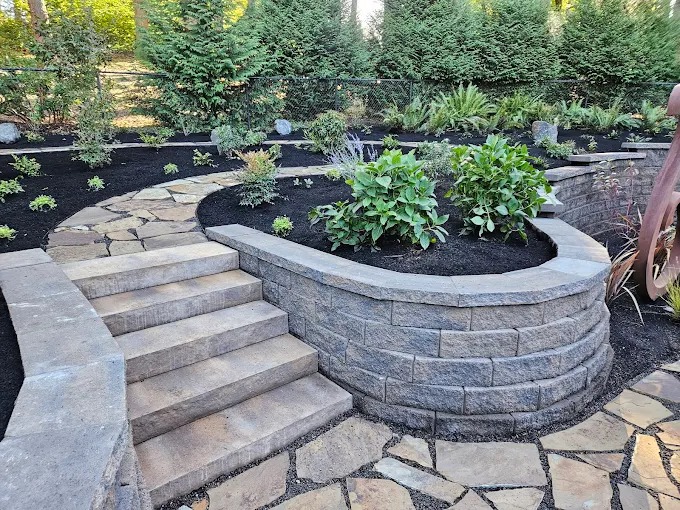
Retaining Wall Installation That Holds for the Long Haul
Walls engineered to hold back wet Oregon slopes, with the drainage that keeps them standing. Serving Portland, Salem, Eugene, and Corvallis.
Retaining Walls and Slope Stabilization for Oregon Yards
A lot of Oregon homes sit on hills. That view comes with a price: slopes that shed mud onto patios, banks that erode a little more every winter, and yards where there is no flat spot to put a table, a play set, or a garden bed. A well-built retaining wall fixes all three problems at once. It holds the slope, stops the erosion, and carves out flat, usable space you did not have before.
The catch is the word well-built. A retaining wall does not just hold dirt. In Western Oregon it holds dirt that is saturated with water for half the year, and water is what destroys walls. Saturated soil pushes far harder against a wall than dry soil does, which is why you see so many leaning, bulging walls around Portland and Salem. Nearly every one of them failed for the same reason: no drainage behind the wall.
We build every wall with that winter in mind: gravel backfill, perforated drain pipe at the base, and a path for water to exit instead of building up pressure behind the blocks. If your slope problem comes with standing water or a soggy yard, we often pair wall work with broader drainage solutions so the whole hillside behaves.
Retaining Wall Blocks, Stone, and Timber: Picking the Right Material
There is no single right material for every wall. The right choice depends on the wall's height, what it is holding back, how visible it is, and your budget. We walk you through the trade-offs at the estimate, but here is the short version:
Segmental Wall Blocks
Engineered concrete blocks that stack and lock together, in finishes from clean and modern to weathered stone looks. They are the workhorse for most residential walls: strong, consistent, and built to take Oregon moisture and freeze-thaw without flaking. For taller walls, they pair with geogrid reinforcement layered back into the slope.
Natural Stone
Basalt and other local stone make beautiful garden walls and terraces that look like they grew out of the Pacific Northwest hillside. Stone costs more in labor but pays it back in looks, and it is a natural fit for shorter garden wall projects and planting terraces.
Timber
Pressure-treated timber walls cost the least up front and suit rustic settings, but wood and Oregon rain are not lifelong friends. We are honest about lifespan: a timber wall is a 15-to-25-year wall, while block and stone walls built with proper drainage can outlast the house.
When a Retaining Wall Needs Engineering
Height changes everything. Most Oregon cities, including Portland, Salem, Eugene, and Corvallis, require a permit and an engineer's stamp once a wall passes roughly four feet tall, measured from the bottom of the footing, or shorter if the wall supports a driveway, structure, or steep slope above it. That is not red tape for its own sake. Taller walls carry real loads, and the soil pressure grows fast with every added foot.
We tell you during the estimate whether your project needs engineering, handle the coordination when it does, and design within standard limits when it does not. Some sloped yards also do better with two shorter terraced walls instead of one tall one. Terracing often avoids the engineering requirement, drains better, and creates planting beds between the walls. It is a trick we use constantly on Willamette Valley hillsides, and it pairs naturally with patios, steps, and other hardscaping.
- Walls over about 4 feet typically need a permit and engineering
- Walls holding driveways or structures need engineering at any height
- Terracing two shorter walls can avoid permits and drain better
- Every wall gets gravel backfill and a drain pipe, code or not
Why Choose Our Retaining Wall Contractors
Drainage Behind Every Wall
Gravel backfill and perforated drain pipe come standard, because trapped water is what tips Oregon walls over.
Compacted Footings
Every wall starts on an excavated, compacted gravel base, not on the soft native clay it is meant to hold back.
Straight Talk on Height
If your wall needs an engineer or a permit, we say so at the estimate and handle the coordination.
Materials for the Climate
We recommend block and stone that shrug off freeze-thaw and constant moisture, and we are honest about timber's lifespan.
Slopes Turned Into Space
Terraced designs convert unusable banks into flat lawn, patios, and planting beds.
Free On-Site Estimates
We walk the slope, measure, and give you a written plan and price at no charge.
Where We Work
Retaining Wall Installation is available from all four of our Oregon locations. Pick your city for local details and a direct phone line.
Common Questions About Retaining Wall Installation
How tall can a retaining wall be without engineering in Oregon?
Why do retaining walls fail or start leaning?
What is the best material for a retaining wall?
Can a retaining wall fix erosion on a slope?
How long does retaining wall installation take?
Our Other Services
Get a Free Retaining Wall Installation Estimate
Send us a photo of your slope or schedule a visit, and we will give you a straight answer on what it takes to hold it.
- Free, no-obligation estimates
- Open 7 days a week, 7 AM to 8 PM
- Serving Portland, Salem, Eugene, and Corvallis
Get Your Free Estimate
Tell us about your project and we will call you back, usually the same day.